

This guide explains how to evaluate odor remediation services by examining their methods, equipment, and ability to prove results. Best Option Restoration serves the Lakewood area with in-person assessments and source-focused odor removal.
- Effective odor removal follows a fixed order - find and remove the physical source, clean contaminated surfaces, treat remaining odor molecules, and verify the smell is gone. Companies that only mask odors or skip source removal will not provide lasting results.
- Different odors require specific treatment methods like thermal fogging for smoke, hydroxyl generators for occupied spaces, ozone for empty structures, and enzyme cleaners for protein-based odors. A company using one method for every job is a red flag.
- Look for IICRC-certified technicians with proper equipment like air scrubbers, moisture meters, and thermal cameras. Ask about warranties, return policies, and documentation of the source removed before signing any agreement.
Start by verifying the company uses detection tools to identify the odor source rather than simply masking it. Ask about their treatment methods - thermal fogging, ozone, or hydroxyl generators work for different situations. Request proof of insurance, check reviews for similar odor types, and get a written guarantee that includes follow-up visits if the smell returns.
A lingering smell after a fire, flood, or pet accident signals a problem that air fresheners cannot fix. Choosing the wrong odor remediation service means paying for treatment that masks the smell for a week, then watching it return.
This post breaks down how to judge an odor remediation service by the methods it uses, the equipment it brings, and the results it can prove. You will learn the questions that separate real odor removal from cover-up work.
What an Odor Remediation Service Should Do
An odor remediation service locates and removes the source of a smell, then treats the affected materials and air. Masking agents alone are a warning sign.
Odors come from particles and gases that embed into porous surfaces. Drywall, carpet padding, subflooring, and HVAC ductwork all hold odor molecules. A company that sprays a scent over the top ignores where the smell actually lives.
Effective odor removal follows a fixed order:
- Find and remove the physical source (fire residue, water-damaged material, biological matter).
- Clean or extract contaminated surfaces.
- Treat remaining odor molecules at the molecular level.
- Verify the smell is gone, not covered.
Any provider that skips step one is selling you time, not a fix.
Evaluate the Techniques Before You Hire
The technique matters more than the price quote. Different odors require different treatment methods, and a skilled company matches the method to the source.
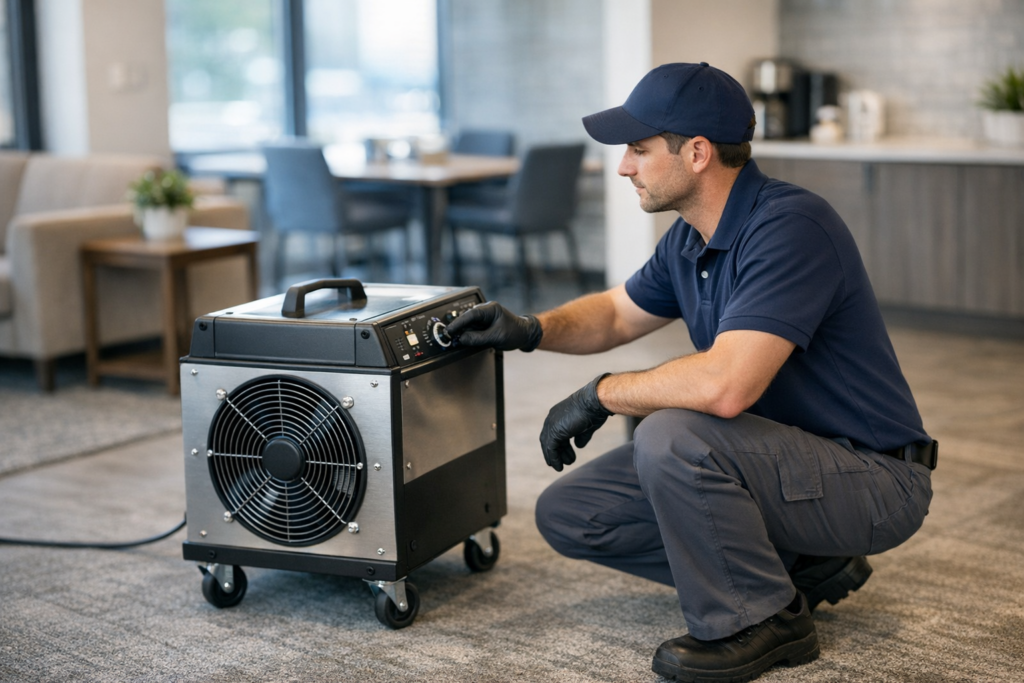
Ask Which Method They Use for Your Specific Odor
Smoke from a kitchen grease fire behaves differently than smoke from a structure fire. Cigarette residue penetrates paint and carpet. Cat urine crystallizes and reactivates with humidity for months.
Match the method to the problem:
- Thermal fogging — recreates the heat penetration of fire smoke, reaching the same pores the smoke reached.
- Hydroxyl generators — safe to run in occupied spaces, break down odor molecules using UV light.
- Ozone treatment — powerful for empty structures, but requires evacuation of people, pets, and plants.
- Enzyme cleaners — target protein-based odors like urine and decomposition at the chemical bond.
A company that names only one method for every job is a red flag. Ask them to explain why they chose a given method for your situation.
Confirm They Address Hidden Materials
Odor sits in places you cannot see. After a flood, water wicks up drywall and soaks into insulation. Bacteria feeding on that moisture produce the musty smell.
A capable team uses moisture meters and, when needed, removes baseboards or cuts inspection openings. If a provider promises results without checking behind walls, they are guessing.
Verify Equipment and Certifications
Equipment separates a functional odor remediation service from a cleaning crew with a spray bottle. The right tools reach odor sources that surface cleaning never touches.
Equipment Worth Asking About
- Air scrubbers with HEPA filtration — capture airborne particles down to 0.3 microns.
- Thermal foggers and hydroxyl generators — treat penetrated materials and active air.
- Moisture meters and thermal cameras — locate hidden water driving mold and musty odors.
- Negative air machines — contain contaminated air during heavy remediation.
Certifications That Signal Real Training
The IICRC (Institute of Inspection, Cleaning and Restoration Certification) sets the recognized standard for restoration work. Look for technicians certified in Odor Control (OCT) and Applied Structural Drying.
Ask for proof of certification and liability insurance. A company that hesitates on either question has told you what you need to know.
Judge the Company by Its Results
Results are the only measure that matters. A good odor remediation service commits to verifiable outcomes, not vague promises.
Questions That Reveal Quality
- How do you confirm the odor is gone? Strong answers mention post-treatment inspection and follow-up checks.
- What happens if the smell returns? A warranty or return-visit policy shows confidence in the work.
- Can you show recent jobs like mine? Photos and references for similar cases prove they handle your odor type.
- Will you document the source you removed? Written documentation protects you and your insurance claim.
Watch for These Warning Signs
- A quote given without inspecting the property in person.
- Heavy fragrance during the sales visit to hide the current smell.
- No mention of finding or removing the source material.
- Pressure to sign before you understand the plan.
Odor that returns within days means the source was never removed. That is the pattern to avoid when choosing odor removal help.
Understand the Timeline and What Drives It
An honest company gives you a realistic timeline based on the odor source. A one-hour fix on a structure fire smell is not credible.
Typical timelines by scenario:
- Pet urine in one room — one to two days after locating all affected spots.
- Kitchen grease fire — two to four days including surface cleaning and fogging.
- Whole-house smoke damage — one to three weeks with material removal.
- Flood-related mold odor — depends on drying time and extent of removal.
A provider who explains what drives the timeline understands the work. Vague speed promises usually mean cover-up methods.

 Posted on Google
Compare Local Response Against Chain Operators
Response time changes outcomes with odor problems tied to water or fire. The longer moisture and residue sit, the deeper the smell penetrates.
A local team reaches your property faster and inspects before conditions worsen. Best Option Restoration serves the Lakewood area with technicians who see these odor sources in person, not over the phone.
Fast, in-person assessment leads to accurate methods and honest timelines. That combination produces odor removal that lasts.
Final Checklist for Choosing Odor Removal Help
Use this short list before you sign any agreement:
- They inspected the property in person.
- They identified the source, not just the smell.
- They matched a named method to your odor type.
- They hold IICRC certification and carry insurance.
- They offered a warranty or return policy.
- They gave a timeline that fits the scope.
If a company meets every point, your odds of permanent odor removal rise sharply.
Conclusion
Choosing odor removal help comes down to source removal, matched techniques, and results you can verify. Judge a company by its methods and equipment, not its cheapest quote or strongest fragrance. The right odor remediation service removes the cause and stands behind the outcome.
Best Option Restoration inspects your property, identifies the odor source, and applies the method that fits. Call or text 303-500-3187, email info@borlakewood.com, or visit https://borlakewood.com to schedule an assessment.
Sources
- IICRC – Institute of Inspection, Cleaning and Restoration Certification
- U.S. EPA – Ozone Generators That Are Sold as Air Cleaners
- CDC – About Mold