

Business continuity restoration focuses on maintaining operations during property damage repairs rather than just fixing the damage. The article outlines steps to keep revenue flowing while restoration work happens.
- Containment is key - sealing off damaged areas with barriers and negative air pressure lets undamaged spaces stay operational. A dental office kept four treatment rooms running while two water-damaged rooms were restored.
- Create a temporary operations plan that maps backup locations, remote work options, critical equipment priorities, and data backup access before disaster strikes.
- Document everything from day one with photos, moisture readings, and daily closure logs to speed up insurance claims. Business interruption coverage may reimburse lost income if you track reduced sales carefully.
To keep your business running during restoration, start by activating your emergency response plan and contacting your insurance provider immediately. Set up temporary operations in an unaffected area or alternate location. Communicate clearly with customers about modified hours or services. Prioritize protecting critical equipment and data while working with restoration professionals to minimize downtime and revenue loss.
A burst pipe floods your retail floor on a Friday afternoon. Your point-of-sale system is down, inventory is soaked, and customers are standing outside confused. The question is not just how to fix the damage. It is how to keep making money while repairs happen.
Business continuity restoration is the practice of maintaining operations during cleanup and repair work after property damage. This post covers the specific steps that keep revenue flowing when your building takes a hit.
You will learn how to isolate work zones, reroute operations, communicate with customers, and work with a restoration crew that understands deadlines matter.
Why Business Continuity Restoration Matters More Than the Repair Itself
Most damaged businesses do not fail because of the damage. They fail because of the downtime. A restaurant closed for three weeks loses regulars who find somewhere else to eat.
Studies on small business recovery show that extended closures after disasters push many companies into permanent shutdown. The faster you resume partial operations, the better your odds.
The goal is partial operation first, full recovery second. You rarely need the entire building to serve customers. You need the parts that generate income.
The Hidden Costs of Being Closed
- Lost daily revenue that never comes back
- Payroll obligations you still owe to idle staff
- Customer migration to competitors during your absence
- Lease and loan payments that continue regardless of sales
- Reputation damage if people assume you closed for good
Step One: Separate the Damage Zone From the Work Zone
Containment is the fastest way to stay open during restoration. A skilled crew seals off the affected area with plastic barriers and negative air pressure. The rest of your space stays usable.
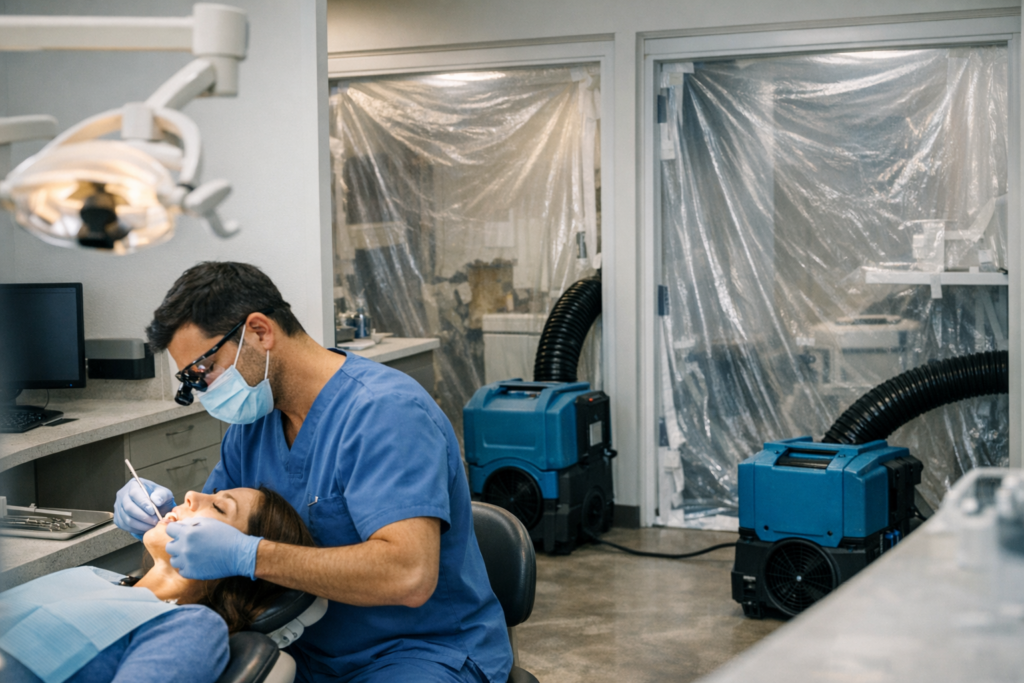
We handled a dental office where water damage hit two treatment rooms. By sealing those rooms and running air scrubbers, the practice kept four other rooms running. They lost zero appointment days.
How Containment Keeps You Operating
- Physical barriers block dust, debris, and moisture from clean areas
- Negative air machines pull contaminated air away from occupied spaces
- Separate entrances let crews work without crossing your floor
- Scheduled work windows keep loud tasks outside business hours
Ask your restoration team whether the affected zone can be isolated before they begin. This single question changes your entire timeline.
Step Two: Build a Temporary Operations Plan
Commercial restoration planning works best when you map alternatives before you need them. A temporary operations plan lists how each function continues if its usual space is unavailable.
Write down what runs where if your main area goes offline. This document saves hours of panic during an actual event.
What to Include in the Plan
- Backup locations for customer-facing work, even a rented space or partner site
- Remote work assignments for staff whose jobs do not require the building
- Critical equipment list ranked by what you must recover first
- Vendor and supplier contacts for fast replacement of damaged stock
- Data backup access stored off-site or in the cloud
A coffee shop with a flooded kitchen kept selling pre-packaged items and drinks from a folding table near the door. Revenue dropped but never stopped.
Step Three: Protect Your Inventory and Equipment Early
Fast content handling decides how much you keep. The first 24 to 48 hours after water or fire exposure determine whether items are salvageable.
Our crews pack out, inventory, and move undamaged goods to dry storage. Electronics, documents, and machinery get specialized drying before corrosion sets in.
Triage Your Assets Like This
- Revenue-critical items first — anything you sell or use to serve customers
- Hard-to-replace items second — records, custom machinery, specialized tools
- Replaceable items last — standard furniture and general supplies
Photograph everything before it moves. This record speeds up your insurance claim and reduces disputes later.
Step Four: Communicate With Customers and Staff
Silence costs you customers. People assume the worst when they see a closed sign and hear nothing. Clear updates keep them loyal during repairs.
Tell customers exactly what is open, what is limited, and when full service returns. Honesty builds patience.
Communication Checklist
- Post signage explaining you remain open during restoration
- Update your website banner and Google Business listing hours
- Send a short email or text to your regular customer list
- Brief staff daily so everyone gives the same answer
- Use social media to show progress, not just problems
A retail client posted weekly repair photos online. Customers started checking in to cheer the reopening. The attention boosted sales the week they fully returned.

 Posted on Google
Step Five: Work the Insurance Claim in Parallel
Insurance delays stall recovery when you wait to start. Documentation and cleanup can happen at the same time if you organize correctly.
We provide detailed moisture readings, photos, and itemized scopes that adjusters accept quickly. This paperwork moves your claim while physical work proceeds.
Keep These Records From Day One
- Dated photos and video of all damage before cleanup
- Written scope of work from your restoration team
- Receipts for temporary measures and lost inventory
- Daily logs of closures and reduced capacity
Business interruption coverage may reimburse lost income. Track every closed hour and reduced sales day to support that part of your claim.
Step Six: Choose a Restoration Partner That Respects Your Clock
The crew you hire determines whether you reopen in days or weeks. A team that works around your schedule protects your revenue. One that treats your business like an empty house does not.
Ask any restoration company how they keep clients operating during the job. The answer reveals whether they understand commercial work.
Questions to Ask Before Hiring
- Can you contain the damage so we stay partially open?
- Will you schedule loud or disruptive work after hours?
- How fast can you start on-site after I call?
- Do you handle the insurance documentation directly?
- What is your realistic timeline for partial and full reopening?
Best Option Restoration treats downtime as the enemy. We plan each phase around keeping your doors open and your customers served.
Putting Business Continuity Restoration Into Practice
Staying open during repairs comes down to isolation, planning, fast asset protection, and clear communication. Each step shortens the gap between damage and full recovery.
The businesses that recover fastest prepare before disaster strikes and act within hours after it does. Commercial restoration planning turns a crisis into a manageable interruption.
Damage does not have to mean closure. With the right containment, documentation, and crew, you keep earning while your space heals.
Keep Your Doors Open With Best Option Restoration
When water, fire, or storm damage threatens your operations, every hour counts. Best Option Restoration responds fast and builds the job around keeping your business running.
Call or text 303-500-3187, email info@borlakewood.com, or visit https://borlakewood.com to start your business continuity restoration plan.
Sources
- FEMA – Protecting Your Business
- Ready.gov – Business Continuity Plan
- U.S. Small Business Administration – Prepare for Emergencies