
Smoke damage leaves two problems behind: fine particles you can see as haze and gases you smell for weeks. A standard air purifier for smoke damage handles one of those at a time, which is why many people buy a unit and still smell smoke a month later. This post shows you how to pick a machine that clears both.
You will learn the exact specs that matter, how to size a unit to your room, and the mistakes that leave your house smelling like a campfire. The advice below follows EPA sizing rules and reflects what we see in Front Range homes after fire events.
Why Smoke Damage Needs a Specific Kind of Air Purifier
Smoke is a mix of solid particles and chemical gases. The two require different filter media to remove. One filter alone leaves half the problem in your air.
HEPA filtration captures the particles. True HEPA filters can capture up to 99.97% of particles as small as 0.3 microns, effectively reducing smoke particulates in the air. That clears the visible haze and the soot that irritates lungs.
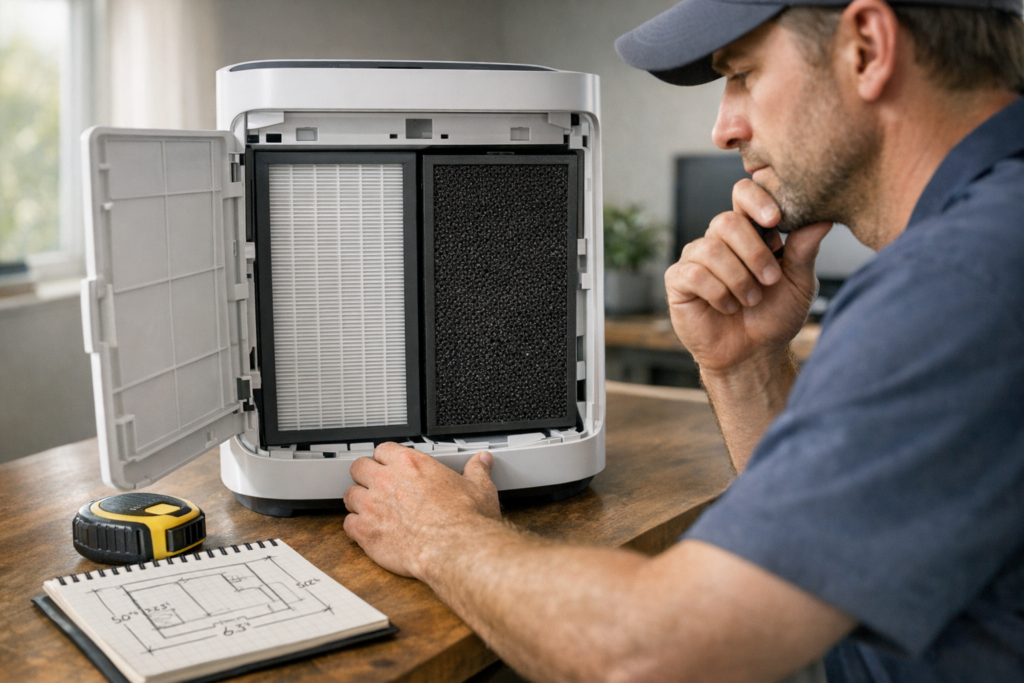
Activated carbon captures the gases and odor. HEPA captures the visible smoke particles; activated carbon adsorbs the gases, fumes, and the smell that makes smoke linger in a room for hours after the source is gone. Skip the carbon, and your air looks clean but still smells like fire.
Fire gases are not trivial. Wildfire smoke contains PM2.5 particles, yes, but also acrolein, benzene, formaldehyde, and nitrogen dioxide — gases that CADR testing doesn’t measure at all. A thin carbon pad will not touch them for long.
Choosing Air Purifiers for Smoke: The Three Specs That Matter
When choosing air purifiers for smoke remediation, three numbers decide whether the unit works. Marketing labels like “True HEPA” on the box tell you almost nothing on their own.
1. Smoke CADR Sized to Your Room
CADR stands for Clean Air Delivery Rate. The smoke CADR number tells you how fast a unit clears particles from a given space. Start here, not with the word “HEPA” or the advertised maximum room size.
The EPA gives a clear sizing rule. Choose an air cleaner with a smoke CADR of at least two-thirds of the room’s area in square feet. A 300-square-foot room needs a smoke CADR of at least 200.
After active smoke damage, size up. For wildfire smoke specifically, AHAM recommends selecting a unit whose Smoke CADR equals the room’s square footage — more demanding than the general two-thirds rule. A 400-square-foot room calls for a smoke CADR near 400.
Here is a quick reference for sizing a unit after smoke damage:
- 150 sq ft bedroom: smoke CADR of 100 (EPA minimum) to 150 (heavy smoke)
- 300 sq ft living room: smoke CADR of 200 to 300
- 500 sq ft open area: smoke CADR of 335 to 500
2. A Real Activated Carbon Stage
Carbon weight is where cheap units fail. A thin mesh coated in carbon dust saturates fast and stops removing odor within weeks.
The amount of carbon matters: budget purifiers typically include 0.5 lb of carbon, which saturates within weeks under heavy smoke conditions. For real smoke damage, you want more.
A practical floor for smoke odor removal is a true HEPA filter rated H13 plus carbon. For wildfire smoke specifically, you need a true HEPA filter rated H13 or higher, an activated carbon layer of at least 2–3 pounds (not a thin mesh), and a CADR number that’s at least two-thirds of your room’s square footage.
For heavy fire damage, carbon capacity separates the workhorses from the toys. Some dedicated smoke units carry 15 pounds of carbon and zeolite, roughly ten times what a standard purifier holds. That volume keeps removing odor for months instead of weeks.
3. Low or No Ozone Output
Some devices marketed for odor produce ozone, a lung irritant you do not want in a home recovering from smoke. Pick a unit certified by the California Air Resources Board (CARB). A CARB listing confirms the device stays within safe ozone limits.
How to Choose an Air Purifier After Smoke Damage: Step by Step
Follow these steps in order. Each one rules out units that look fine on the box but fail in a smoke-damaged room.
- Measure the room. Multiply length by width for square footage. Pick the room you spend the most time in first.
- Set your target smoke CADR. Use room square footage for recent smoke damage, or two-thirds of it for lighter odor.
- Confirm a true HEPA stage. Look for “True HEPA” or “H13,” not “HEPA-type.”
- Check the carbon weight. Aim for at least 2 to 3 pounds for odor, more for heavy damage.
- Verify a CARB listing. This caps ozone output at a safe level.
- Check the noise rating. You will run it on high for weeks, so pick a unit quiet enough to sleep near.
- Confirm filter availability and cost. Smoke saturates filters fast; know the replacement price before you buy.
HEPA vs. Activated Carbon: Which Does What
People often ask which filter type is better for smoke. The honest answer is you need both, and each does a separate job.
- HEPA filter: captures visible smoke particles, soot, and PM2.5 down to 0.3 microns. Clears the haze and protects your lungs.
- Activated carbon filter: adsorbs gases, VOCs, and the lingering smoke smell. Clears the odor HEPA leaves behind.
The EPA states the pairing plainly. A portable air cleaner with a high CADR and an activated carbon filter can filter both particles and gases. A unit with one and not the other solves half the problem.

 Posted on Google
Running the Purifier for Best Results
Buying the right unit is step one. How you run it decides how fast the air clears.
Run it on the highest setting. During a wildfire smoke event, it is recommended to use the highest fan setting on the portable air cleaner. The minimum CADR is calculated based on the highest fan setting, and so running your air purifier on this setting will ensure you are most effectively filtering the air.
Set up one clean room and seal it off. Close windows and doors, and keep the unit running around the clock. Concentrating the machine in one space clears it far faster than spreading weak airflow across the house.
Change filters more often than the manual says. Filters should be checked and replaced more frequently during wildfire smoke events. Smoke loads a filter in a fraction of its normal life, and a saturated carbon filter stops removing odor entirely.
Where a Portable Unit Reaches Its Limit
A good air purifier for smoke damage handles airborne particles and odor in the room you place it. It does not remove smoke residue bonded to walls, ceilings, carpet, and ductwork.
That residue keeps re-releasing odor into the air. You can run a purifier for months, but if soot coats your surfaces, the smell returns every time the carbon saturates. Source removal has to happen alongside air filtration.
After significant fire or smoke damage, surface cleaning, thermal fogging, HVAC cleaning, and sealing are what remove the odor source. A purifier manages the air during and after that work; it is not a substitute for it.
Key Takeaways
The right air purifier after smoke damage pairs a true HEPA stage with at least 2 to 3 pounds of activated carbon, sized so the smoke CADR matches your room’s square footage. Run it on high in a sealed room, and change filters early and often. For odor bonded to your walls, carpet, and ducts, filtration alone will not finish the job.
If smoke damage has left your Lakewood home or business with lingering odor and residue, Best Option Restoration of Lakewood can assess the source and handle full smoke remediation. Call or text us at 303-500-3187, email info@borlakewood.com, or visit https://borlakewood.com.