
Selecting the right commercial decontamination services protects staff, customers, and business reputation after contamination events like sewage backups, biohazard incidents, or viral outbreaks.
- Commercial decontamination covers biohazard cleanup, sewage treatment, mold remediation, viral disinfection, and chemical spills - each requiring different equipment and protocols. Match providers to your specific property type since medical offices, restaurants, and warehouses have different regulatory requirements.
- Ask providers seven key questions covering IICRC certification, response time guarantees, pollution liability insurance, waste disposal documentation, clearance testing capabilities, insurance carrier experience, and crew consistency.
- Avoid common mistakes like choosing based on price alone, using janitorial services for biohazard work, or ignoring insurance coordination. Proper documentation supports claims and proves spaces are safe to reoccupy.
To choose the right decontamination services, evaluate the company's certifications, response time, and experience with your specific contamination type - whether sewage backup, biohazard incident, or viral outbreak. Verify they use EPA-approved disinfectants, follow OSHA guidelines, and provide documentation for compliance. Quick response capability and proper insurance coverage are also key factors to consider.
A single contamination event can shut down a commercial property for days. Whether it stems from a sewage backup, a biohazard incident, or a viral outbreak, the wrong cleanup choice puts your staff, customers, and reputation at risk. Picking the right commercial decontamination services protects all three.
This article breaks down what separates a capable provider from a risky one. You will learn which certifications matter, how to match a vendor to your property type, and the questions that expose gaps before they cost you.
What Commercial Decontamination Services Actually Cover
Commercial decontamination is the removal, neutralization, and disposal of harmful biological, chemical, or environmental contaminants from a business property. It goes far beyond standard janitorial cleaning.
A janitor wipes surfaces. A decontamination crew treats the source, contains the spread, and verifies the space is safe to reoccupy.
The scope changes based on the contaminant. Common scenarios include:
- Biohazard cleanup — blood, bodily fluids, or trauma scenes requiring OSHA-compliant handling
- Sewage and Category 3 water — wastewater carrying bacteria and pathogens
- Mold remediation — spore containment and air scrubbing in HVAC-connected spaces
- Viral and bacterial disinfection — surface and air treatment after outbreaks
- Chemical spills — neutralizing and removing hazardous materials
Each one demands different equipment, training, and disposal protocols. A provider strong in one area may be weak in another.
Match the Provider to Your Property Type
Different commercial properties carry different risks. The right vendor has worked in spaces like yours and knows the rules that apply.
Medical and Dental Offices
Healthcare facilities face strict regulatory oversight. Decontamination here must follow bloodborne pathogen standards and medical waste disposal laws.
Ask whether the crew has handled regulated medical waste manifests. A general cleaner usually has not.
Restaurants and Food Service
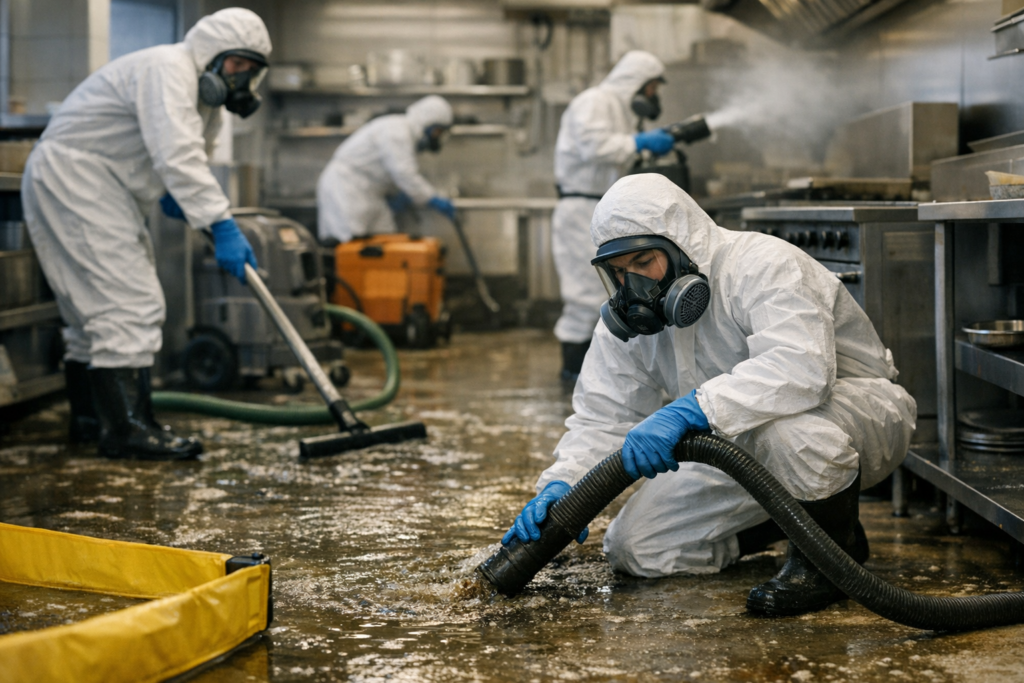
A sewage backup in a commercial kitchen can trigger a health department closure. Speed and documentation both matter.
The provider should produce records proving full sanitization. You need that paperwork to reopen.
Office Buildings and Multi-Tenant Spaces
Shared HVAC systems spread contaminants between suites. Containment becomes the priority before treatment begins.
A capable crew isolates the affected zone and protects neighboring tenants from cross-contamination.
Warehouses and Industrial Sites
Large square footage and chemical exposure define these jobs. Confined-space entry training and proper PPE are non-negotiable.
Seven Questions to Ask Before You Hire
Vet every provider with direct questions. The answers reveal whether a company can handle your situation or is improvising.
- Are you certified by the IICRC? The Institute of Inspection, Cleaning and Restoration Certification sets the recognized standard for cleanup work.
- What is your response time? For active contamination, hours matter. Ask for a guaranteed window, not a vague promise.
- Do you carry pollution liability insurance? General liability rarely covers contamination work. Confirm the right coverage exists.
- Who disposes of the waste, and how? Improper disposal can leave your business liable. Ask for the disposal chain and documentation.
- Can you provide clearance testing? Verification that a space is safe protects you legally and physically.
- Have you worked with my insurance carrier? A vendor familiar with claims paperwork shortens your recovery time.
- Will the same crew handle the full job? Subcontracted labor introduces inconsistency. Know who shows up.
A reliable provider answers each without hesitation. Evasive responses are a warning sign.
Why Certification and Documentation Matter
Certification proves a crew was trained to recognized standards. Documentation proves the work was done correctly.
For a business, both create a paper trail. That trail supports insurance claims, satisfies health inspectors, and shields you from liability.
Consider a sewage backup in a retail store. Without clearance testing records, you cannot prove the floor is safe. A slip-and-fall claim later becomes much harder to defend.
The OSHA Bloodborne Pathogens Standard requires specific handling for blood and infectious material. A provider ignoring it exposes your staff and your company to fines.
Speed Without Shortcuts
Fast response limits damage. But speed cannot replace correct procedure.
A crew that rushes containment risks spreading contamination into clean areas. That mistake doubles the cost and the downtime.
The right balance looks like this:
- Immediate containment to stop the spread
- Source removal before surface treatment
- Treatment and disinfection using EPA-registered products
- Drying and air filtration where moisture or spores exist
- Clearance verification before reoccupancy
Skipping any step risks a recurrence. Business cleaning solutions that follow this order produce lasting results, not temporary fixes.

 Posted on Google
Common Mistakes Businesses Make When Hiring
Many owners pick a provider under pressure and regret it. Avoiding a few errors saves money and downtime.
Choosing on Price Alone
The cheapest bid often skips containment or testing. Those skipped steps surface later as repeat contamination.
Assuming a Janitorial Service Can Handle It
Routine cleaning crews lack biohazard training and disposal licensing. Asking them to handle Category 3 water puts everyone at risk.
Ignoring Insurance Coordination
A provider who documents poorly can sink your claim. Pick one who works directly with adjusters and supplies clear records.
How Best Option Restoration Handles Commercial Work
Best Option Restoration treats commercial decontamination services as a controlled sequence, not a quick wipe-down. Each job starts with assessment and containment before any treatment begins.
The team documents conditions, treatment steps, and final verification. That record supports your insurance claim and your reopening timeline.
For business owners, the goal is straightforward: a property returned to safe, usable condition with proof to back it. Reliable business cleaning solutions reduce downtime and protect the people who walk through your doors.
Final Takeaways
The right commercial decontamination services combine fast response, recognized certification, and complete documentation. Match the provider to your property type, ask the seven vetting questions, and never choose on price alone. Verification at the end matters as much as speed at the start.
Best Option Restoration handles commercial decontamination for offices, medical facilities, retail, and industrial sites. Call or text 303-500-3187, email info@borlakewood.com, or visit https://borlakewood.com to get a response started.
Sources
- OSHA – Bloodborne Pathogens and Needlestick Prevention
- EPA – Selected EPA-Registered Disinfectants
- IICRC – Institute of Inspection, Cleaning and Restoration Certification
- CDC – Cleaning and Disinfecting Your Facility